Military aircraft parked inside a hangar seen from above

Scale Exploitation with the Growth of Collection

Collection is compounding, creating an opportunity to dramatically expand analyst reach. You must move beyond predefined target decks, BE facilities, and one image at a time analysis to exploit broader areas, more frequent collects, and a growing sensor base.

More sensors. More frequent collection. More imagery arriving from across the battlespace. Proliferating drones and next generation uncrewed ISR systems make scalable exploitation a requirement, not an optimization.

Analytic teams are often structured around RFIs, KIQs, and PIRs tied to known locations and established targets. That model works well for persistent monitoring, but those locations represent only a fraction of the broader AOR. Peer adversaries are increasingly adept at masking TTPs during competition, rapidly adapting during conflict, and managing the RF and other Multi-INT signatures we have traditionally relied upon. As those cues become harder to detect or deliberately obscured, dynamic operations demand the ability to look beyond predefined sites, staging areas, and facility boundaries. The most consequential activity may be occurring outside the places already under watch.

enterprise collection

  • 325MUnclassified images delivered by NGA in 2024
  • 400K+NRO collections in 2025 from its proliferated architecture
  • 10×More signals and images expected from the next-generation overhead architecture

Sources: [1] VADM Whitworth, 2025 GEOINT Symposium keynote, NGA; [2] NGA prepares to use Generative AI for mission support

Extract Decision Advantage From Every Pixel.

RAIC's Impact

Imagery Exploitation Across the Mission Thread

RAIC enables broader search, persistent awareness, and rapid imagery triage across diverse mission threads, helping analysts move faster from collection to understanding.

01 / LONG-RANGE KILL CHAIN

Add "Find" to F2T2E

"Find" means discovery, not just confirming threats against known locations and signatures. RAIC uses like object search and clustering to reduce location bias and help analysts discover unknown objects while searching for known ones.

How it works
02 / GEOINT

Pattern of Life Beyond Fixed AORs

Baseline a site, aggregate change over months, and surface anomalous activity using the secondary objects no detector was ever built for. Extend the analysis to support forensic review, identify emerging indicators, and reveal the logistics, staging, and support chains behind operational activity.

How it works
03 / ATR

Rapidly Characterize Collections

Triage scenes at scale to decide where expensive ATR should run, turning an underused model catalog into targeted, affordable coverage.

How it works
01 — Long-range kill chain

Turn your AOI into your AOR.

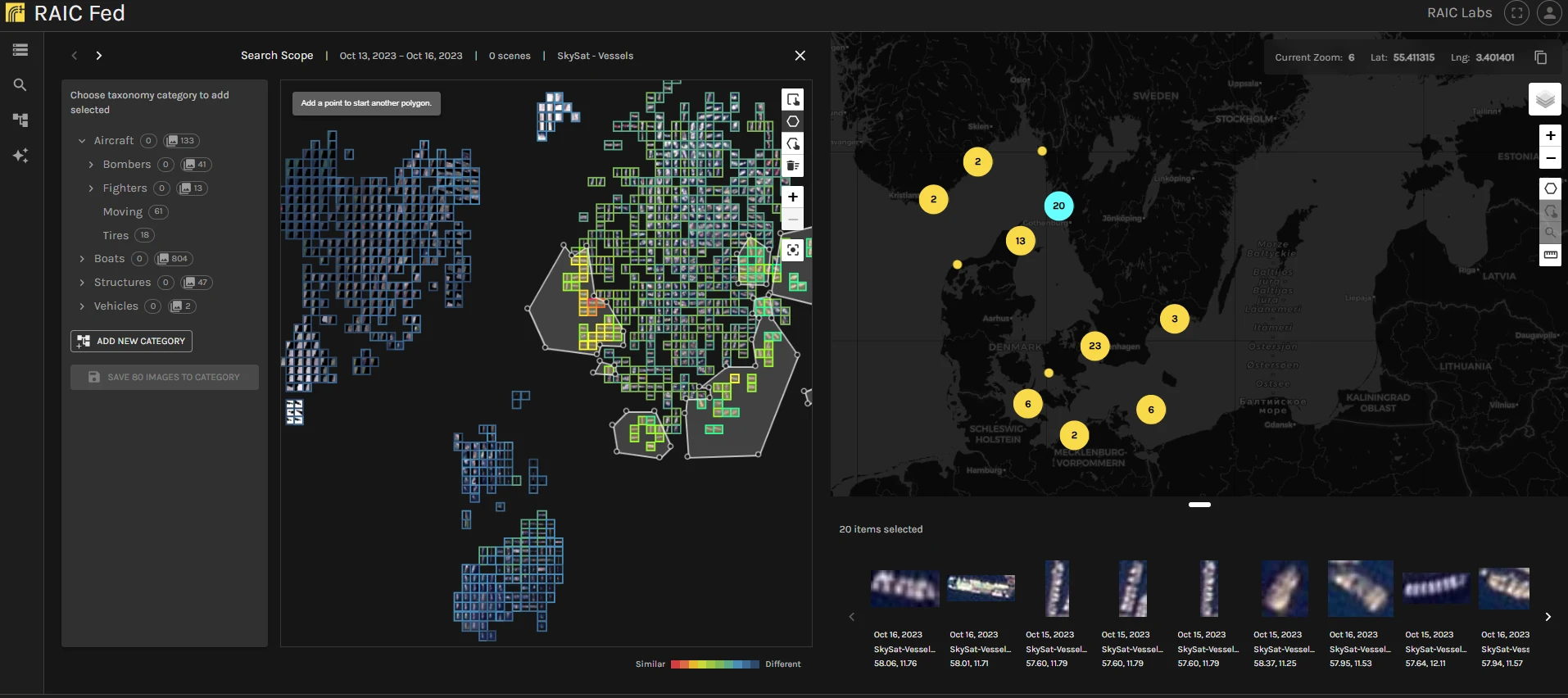
Hyper-scaled broad area search lets an analyst interrogate an entire theater from as little as one example, then validate results in like-object clusters rather than one frame at a time.

  • Find anything from a single example, including objects with no model and no prior imagery
  • Cluster detections so a human confirms thousands of images in minutes, not weeks
  • Quickly separate what is real, what is noise, and what is genuinely new
  • Extend target custody by handing confirmed locations to existing ATR for monitoring
  • Reacquire adversary threat objects through broad area search when traditional object-custody methods fail
RAIC context map with clustered results and detections shown in geographic contextMove from semantic clusters to geographic context
Mitigating multi-INT risk

Search the whole ellipsoid, not just its center point.

When SIGINT detects a potential threat object, GEOINT is often tasked to confirm at the center point of the uncertainty ellipsoid. That can create a false sense of precision: a candidate object at the center may appear to validate the attribution even though the true source could exist anywhere within the broader area. Peer adversaries are RF-smart, and as they manage, mask, or manipulate signatures, center-point cueing becomes increasingly unreliable.

RAIC treats the full ellipsoid as the search space rather than a single point. Teams can collect and search the area holistically, evaluate candidate objects statistically, refine attribution as evidence accumulates, and maintain awareness of viable candidates through continuous monitoring and traditional collection.

Searching a whole SIGINT ellipsoid instead of only its center point A signal ellipsoid provided by SIGINT. The attributed target sits at the collected center point. A second candidate target appears further down inside the ellipsoid, along with several other collects that still require review. Signal ellipsoid Provided by SIGINT Attributed target Center point collected today Potential second target The signal fits this object too Other collects in the ellipsoid Each one still requires review before the ellipsoid is cleared Holistic ellipsoid exploitation
Persistent awareness

RAIC across the targeting cycle.

The same indexed representation supports every phase, so custody does not break when the mission moves between them.

FIND

Asymmetric threat discovery

Expanded AOR search exposes adversary activity operating outside known garrison and staging locations.

FIX

Confirmation in context

Search results carry visual timeline and location context, so an analyst confirms the target rather than inferring it.

TRACK / TARGET

Custody and reacquisition

Shallow model monitoring holds custody; broad area search reacquires the object when its appearance changes.

ENGAGE / ASSESS

Quick-look assessment

Search and clustering support combat assessment and change detection immediately after action.

02 — GEOINT

Surface intent beyond predefined detections.

The primary object is often only part of the picture. Movement, staging, support activity, surrounding change, and other secondary indicators can reveal intent before the object of interest changes state.

  • Establish long and short term pattern of life across facilities, regions, and mobile activity
  • Identify secondary indicators that precede movement, deployment, launch, or other state changes
  • Aggregate change across repeated collections to surface anomalous or emerging activity
  • Correlate imagery derived indicators with external data sources to strengthen confidence
  • Adapt quickly to new objects, behaviors, and indicators without waiting for a predefined detector
Launch-cycle indicators around a single site A rocket body on a launch pad is the only predefined detection. Around it, three non-traditional indicators appear: a normally empty parking lot filling with vehicles, an aircraft flying without ADS-B, and a telemetry ship leaving port. Rocket body on the pad The one predefined detection Parking lot filling Empty on every prior collect Aircraft flying dark No ADS-B, no flight plan Telemetry ship leaving port Under way ahead of schedule Indicators around one launch site
03 — ATR

Extend Coverage Beyond the Model Library

Traditional ATR programs continue to add models, but the growing model library is already difficult to task, manage, and deduplicate and still represents only a fraction of the objects analysts need across different AORs, sensors, and conditions.

Cost

Use GPU-intensive models selectively. Use the embedding space broadly.

Conventional computer vision expands by adding specialized models, each with its own inference workload and compute cost. RAIC shifts broad search, clustering, categorization, and monitoring into a reusable embedding space, allowing teams to reserve GPU-intensive models for the tasks where their precision and automation provide the greatest advantage.

Fragility

Maintain Detection Despite Visual Deception

Camouflage, concealment, markings, and other visual changes can degrade detectors trained on a fixed appearance. RAIC uses a feature-rich embedding representation that captures deeper visual characteristics beyond raw pixel similarity, making detection and search less rigid as objects change and adversary TTPs evolve.

Speed

Create, refine, and retire detectors rapidly

RAIC enables teams to rapidly stand up embedding based filters and lightweight detectors as collection requirements evolve. New objects, indicators, and areas of interest can be operationalized quickly, refined as more data arrives, and retired when no longer needed without committing to a full labeling, training, and deployment cycle.

SPEED TO DEPLOYMENT

Reduced Authorization Burden

RAIC ships as containerized services designed to integrate with existing DevSecOps pipelines and deploy across commercial cloud, on premises, classified, and fully air gapped environments. A hub and spoke deployment model supports data isolation across enclaves and mission partners while maintaining a consistent application baseline, allowing teams to preserve existing security boundaries, release processes, and authorization controls.

01

Start from an Established ATO Baseline

RAIC has an active Certification to Field for a Top Secret environment. That authorization, along with the supporting security documentation and deployment history, can be reused as a starting point for your environment, giving security teams a proven foundation rather than beginning the accreditation process from scratch.

02

Iron Bank Hardened Images for Faster Accreditation

RAIC maintains hardened and continuously scanned container images aligned with Iron Bank requirements. Standardized artifacts, vulnerability management, and repeatable container builds help reduce friction during security assessment and accreditation.

03

Security Expertise for AO Engagement

RAIC brings experienced security and platform support to work with AOs, ISSOs, ISSMs, and engineering teams throughout deployment. We support security documentation, control implementation, technical findings, remediation, and ongoing authorization requirements as the environment evolves.

Operational proof

Results Against Difficult Real-World Conditions.

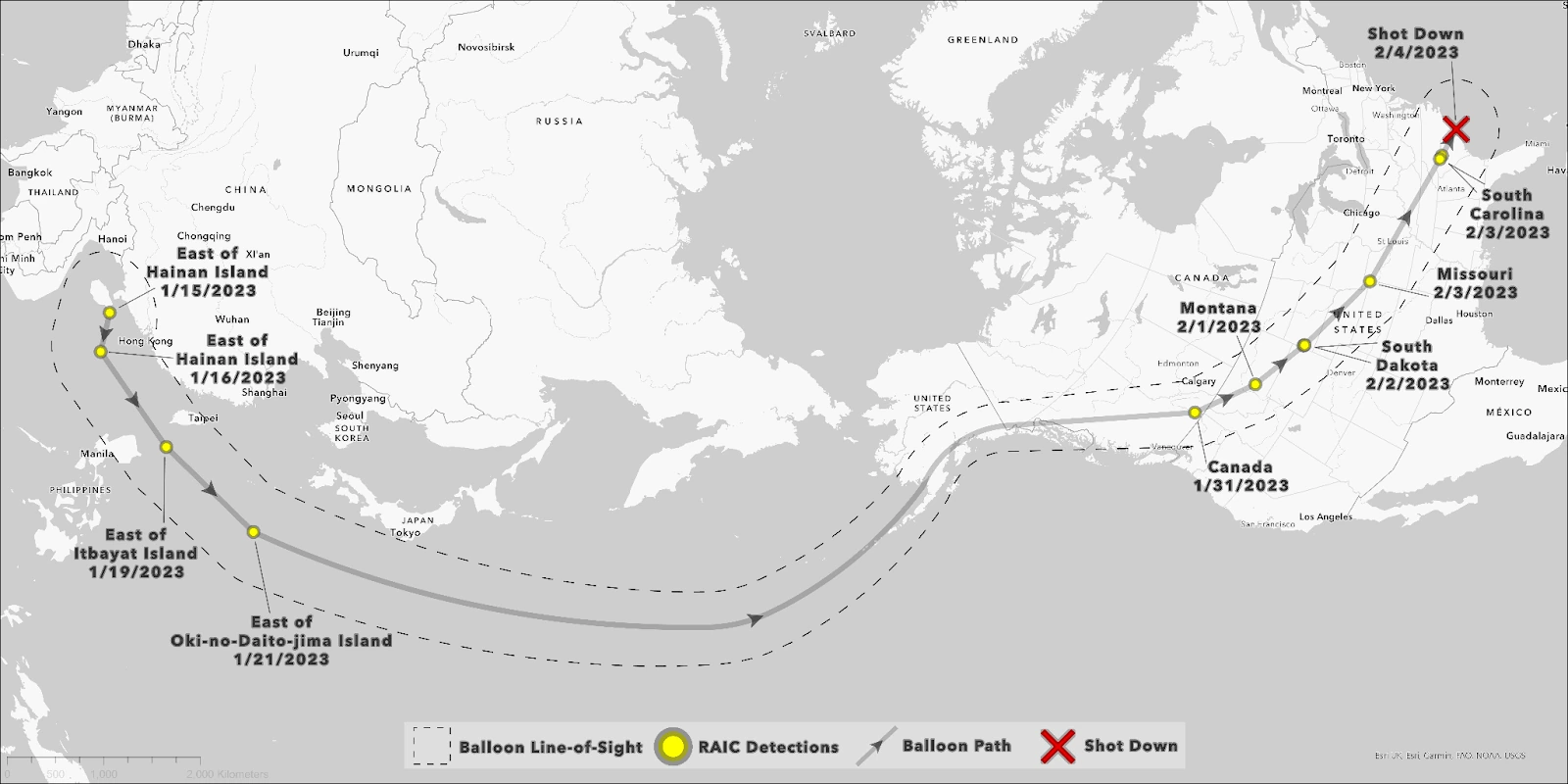
Balloon track plotted across a wide-area satellite mosaic
Unknown unknowns

Chinese surveillance balloon

Starting from a hand-drawn sketch, RAIC found its first positive match in less than two minutes. It located the 150-pixel object within 18 trillion pixels of imagery, detected it 13 separate times, tracked it toward its launch site, and identified dark aircraft operating nearby.

Clandestine airstrip with cratered runway seen from satellite imagery
Denial and deception

50+ illicit airstrips

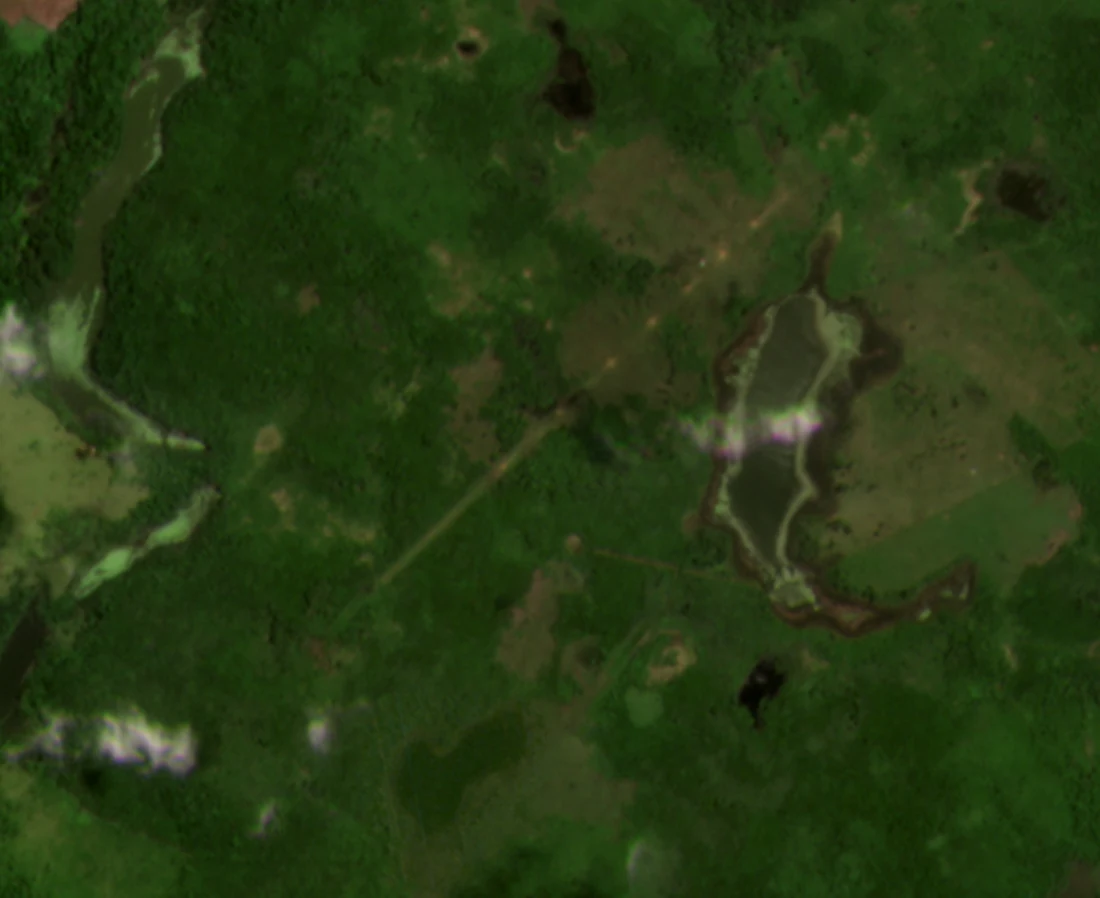
Temporary and illicit airstrips can appear quickly, operate briefly, and vary significantly in visual signature, limiting the effectiveness of fixed detection approaches. RAIC teams used broad area imagery search to identify more than 50 previously unknown airstrips across 2020 and 2021.

Satellite chip in which each aircraft appears as separated red, green, and blue dots
AIRCRAFT IN FLIGHT

Exploit Sensor Phenomenology for Airborne Detection

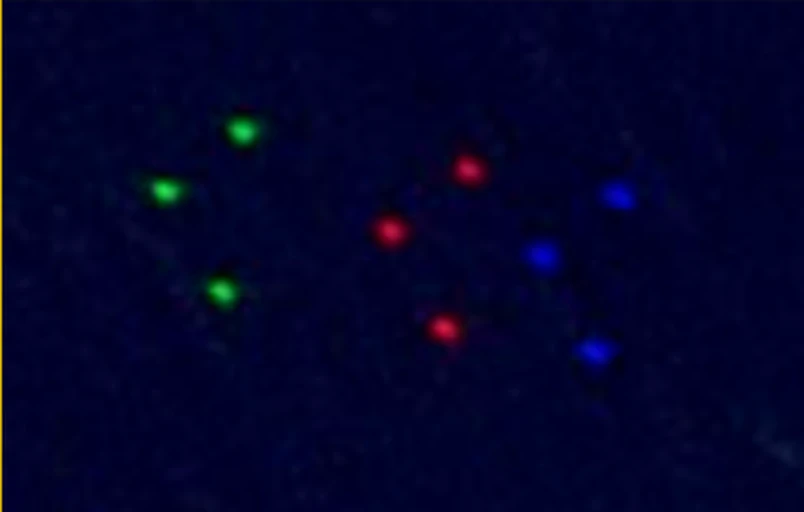
Fast moving airborne objects can produce distinct band separated signatures in multispectral satellite imagery as the sensor captures the scene over time. RAIC exploited this motion induced parallax to identify Blue Angels aircraft in 3 meter imagery near NAS Pensacola, demonstrating detection based on sensor phenomenology rather than a conventional airframe signature.

Satellite view of a Russian naval convoy underway, with a bounding box on the Admiral Kasatonov
Open-source Sentinel-2

Reacquire Maritime Activity Across Repeated Collects

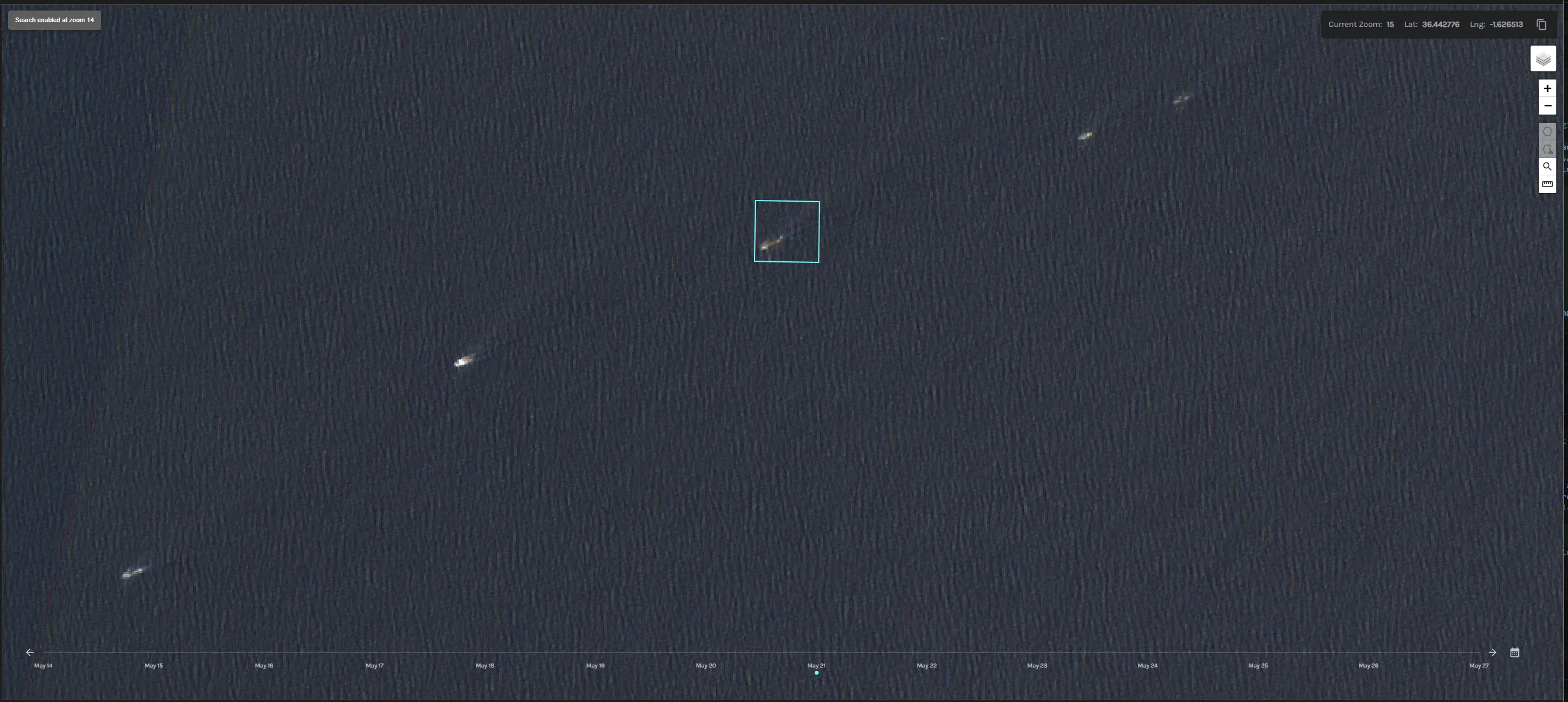
Using an existing vessel category as the starting point, RAIC reacquired the Russian naval formation in open source Sentinel 2 imagery over the Mediterranean during 3 to 8 May. Visual similarity across vessel length, appearance, and wake enabled the formation to be associated across separate collections and changes in relative position to be identified.

The IC and key stakeholders within Trident Spectre should make every effort to invest and continue to evaluate this specific tech, as it has the potential to make amplifying effects on the battlefield right now if used correctly.
NSW G8 SRT SIGINT and OPS/INTEL Analyst — RAIC rated highest capability at Trident Spectre ’23 (88/100), bringing no models and no data, only a laptop
Mission evaluation

Identify the next opportunity in your imagery.

Bring representative imagery, an existing workflow, or a defined problem set. We will explore where RAIC can extend exploitation, surface new indicators, and unlock additional capability from the collection and infrastructure already in place.

Start the Conversation